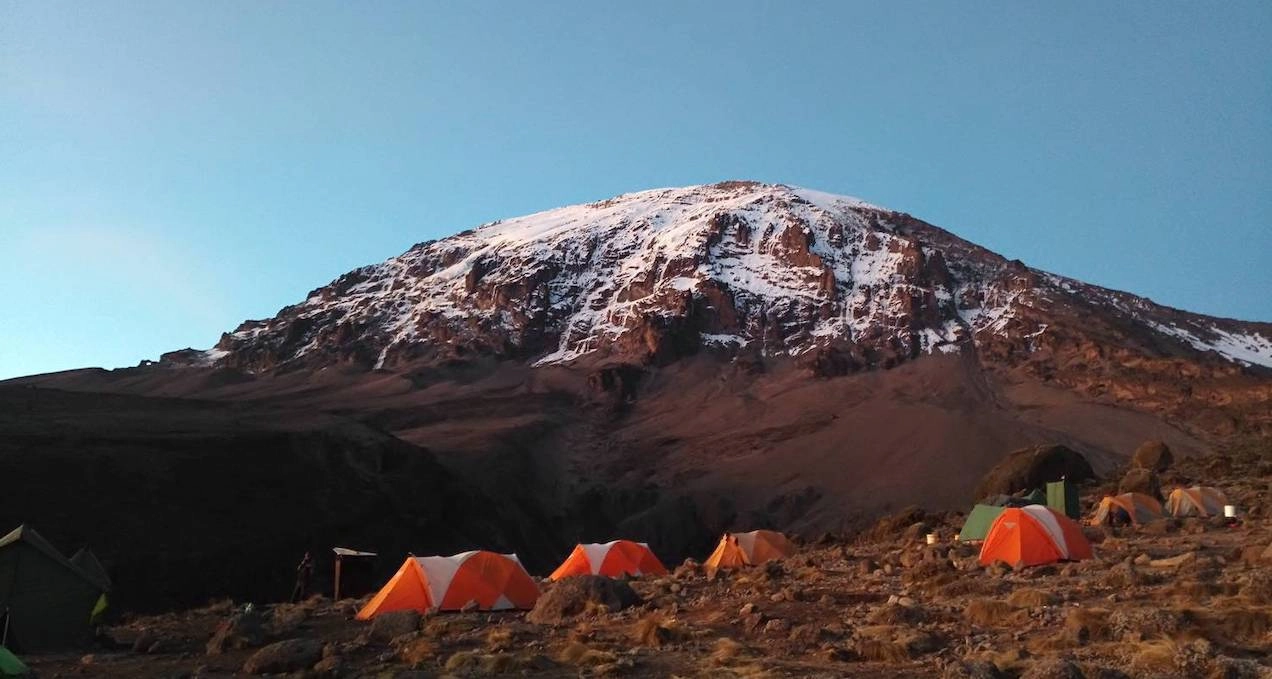
8 Days Northern Circuit Route (Mt. Kilimanjaro)
Kilimanjaro's Northern Circuit Route is the longest and newest trail on the mountain, sweeping around Kibo's remote northern slopes far from the crowded southern paths. Available as an 8-day or 9-day Kilimanjaro trek, it offers near-private trails, unmatched solitude, and the highest summit success rate of any route thanks to superior acclimatization. Ideal for adventurers with time to spare who want sweeping 360° panoramas and a true wilderness expedition.
Highlights:
- The scenic Shira Plateau
- High lava field
- High alpine desert zone
- Kilimanjaro's remote Northern circuit
Itenaries:
Day 1: Lemosho to Mti Mkubwa
Day 1 of the Lemosho route begins with a hotel pickup in Moshi and a scenic drive west to Lemosho Gate (~2,100 m) on Kilimanjaro's western flank. From the trailhead, a gentle afternoon's walk climbs through dense montane rainforest, colobus monkeys and turacos calling from the canopy, before reaching Mti Mkubwa (Big Tree) Camp.
Day 2: Mti Mkubwa to Shira 1
The rainforest thins by mid-morning. We cross the Shira Ridge and step out onto the Shira Plateau, a high lava field with the first dramatic view of Kibo, Kilimanjaro's summit cone. Cool, often windy.
Day 3: Shira 1 to Moir Camp
After breakfast, a gentle hike across the scenic Shira Plateau leads to Shira 2 Camp, set on moorland meadows beside an alpine stream. The trek continues eastward through the 'Garden of the Senecios,' where Kilimanjaro's iconic giant senecio plants thrive, before entering the high alpine desert zone. From here, the trail joins the Northern Circuit Route, descending gently to Moir Hut Camp for a restful overnight stop and valuable acclimatization.
Day 4: Moir to Buffalo Camp (the north)
Today marks the first day of the Great Northern Arc, one of Kilimanjaro's most remote and rewarding sections. Climb to Lent Hills (4,375 m) for sweeping panoramic views across the mountain, then descend to Buffalo Camp on the rarely visited northern slopes, a quieter side of Kilimanjaro known for its solitude and untouched scenery.
Day 5: Buffalo to Third Cave
The northern traverse continues along Kilimanjaro's remote Northern Circuit, offering sweeping views across the vast Kenyan plains and Amboseli landscape below. The trek then continues east around Kilimanjaro's remote northern slopes toward Third Cave Camp on the Rongai Route. By this point, you should be feeling much better acclimatized to the altitude. You'll arrive at Third Cave around mid-afternoon, with time to rest and soak in the dramatic high-altitude scenery.
Day 6: Third Cave to School Hut
The trail today follows a steady, rewarding ascent across the dramatic Saddle, the wide, otherworldly plateau stretching between Kilimanjaro's two iconic peaks, Kibo and Mawenzi. From here, the route bends south-west, climbing gradually toward School Hut Camp, your launch point for the summit push. On arrival, an early dinner is served, giving you time to rest before being woken just before midnight for the final ascent to Uhuru Peak. Use the remaining daylight wisely: lay out your summit gear in advance, including warm layers, insulated water bottles, high-energy snacks, a reliable headlamp, and your camera. A solid few hours of sleep now will make all the difference in what is the most demanding and unforgettable night of the climb.
Day 7: School Hut to Uhuru Peak to Millenium Camp
At around 11:30 PM, your guides will gently wake you with hot tea and biscuits before you set off into the cold, starlit night for the most challenging stage of your Kilimanjaro climb. Bundled up against the freezing temperatures, you'll begin the steep ascent up the slopes of Kibo by headlamp, pausing briefly at Hans Meyer Cave to catch your breath. The trail steepens sharply as you push on toward Gilman's Point (5,681 m) on the crater rim, typically reached 5 to 6 hours after leaving School Hut Camp. Take a moment here to soak in the approaching dawn and the dramatic silhouette of Mawenzi Peak, but dig deep, as Uhuru Peak still lies roughly two hours ahead. The gradient eases as you traverse west along the crater rim, past ancient glaciers, arriving at Uhuru Peak (5,895 m), the Roof of Africa, just around sunrise. Your time at the summit will be brief due to the thin air, so capture as many photos as you can of the breathtaking views and surrounding glaciers before retracing your steps to Stella Point (5,739 m). From here, you'll descend the loose scree slopes of Kibo down to Barafu Camp (4,680 m) for a short rest, then continue to Millennium Camp (3,950 m) for your final night on the mountain. In total, summit day involves 14 to 16 hours of trekking, making it the longest and most demanding day of the climb, so pace yourself carefully, stay well hydrated, and keep your blood sugar topped up with regular snacks.
Day 8: Millenium Camp to Mweka Gate
A gentle morning through the rainforest, certificate ceremony at Mweka Gate, from where you will have a feedback session and then be dropped off at your hotel.